
The Stabicraft 1410 is one of the most successful small boats ever built in New Zealand. At 4.3 m long, the Invercargill-built aluminium boat with Stabicraft’s sealed buoyancy pontoons was sold as a tiller-steer Explorer, an open Fisher and a centre-console Frontier, and it became a favourite for harbour fishing, diving, family fun and as a tender. This guide covers the versions, what they are like to own, what to check, and what they are listed for on boats.co.nz.
The short version
- Best for: inshore fishing and diving, lakes and rivers, first-time boat owners and anyone who wants a light, safe, low-maintenance boat they can tow and launch easily.
- Strengths: very stable thanks to the pontoon design, tough plate aluminium, light to tow, simple to own, and strong resale.
- Weaknesses: a small boat with limited range and shelter, a firm and sometimes wet ride in chop compared with larger boats, and room for only about four people.
- Typical asking price (late 2026): most recent listings sit between about $16,000 and $30,000, with a median of $22,495.
Specifications
| Length | 4.30 m (14 ft 1 in) |
| Construction | Plate aluminium hull with sealed buoyancy pontoons |
| Versions | Explorer (tiller), Fisher (open boat), Frontier (centre console) |
| Capacity | Up to four adults |
| Typical engines | 30-50 hp outboards (15-60 hp seen in our listings) |
| Fuel | Portable tote tank |
| Built | Invercargill, New Zealand, until replaced by the 1450 in 2020 |
History and versions
Stabicraft started in Invercargill in 1987 and made its name with its distinctive aluminium boats built around sealed buoyancy pontoons, designed to stay afloat and stable even when swamped. The 1410 was the smallest boat in the range for most of its life and became one of the company’s best sellers. Boating magazines described it as an all-rounder for inshore fishing, towing water toys, diving and exploring inland waterways.
You will see three main versions for sale:
- 1410 Explorer: tiller-steer, with raised coamings and an open layout. The simplest and lightest version, popular as a tender and for lakes and rivers.
- 1410 Fisher: the no-frills open fishing version.
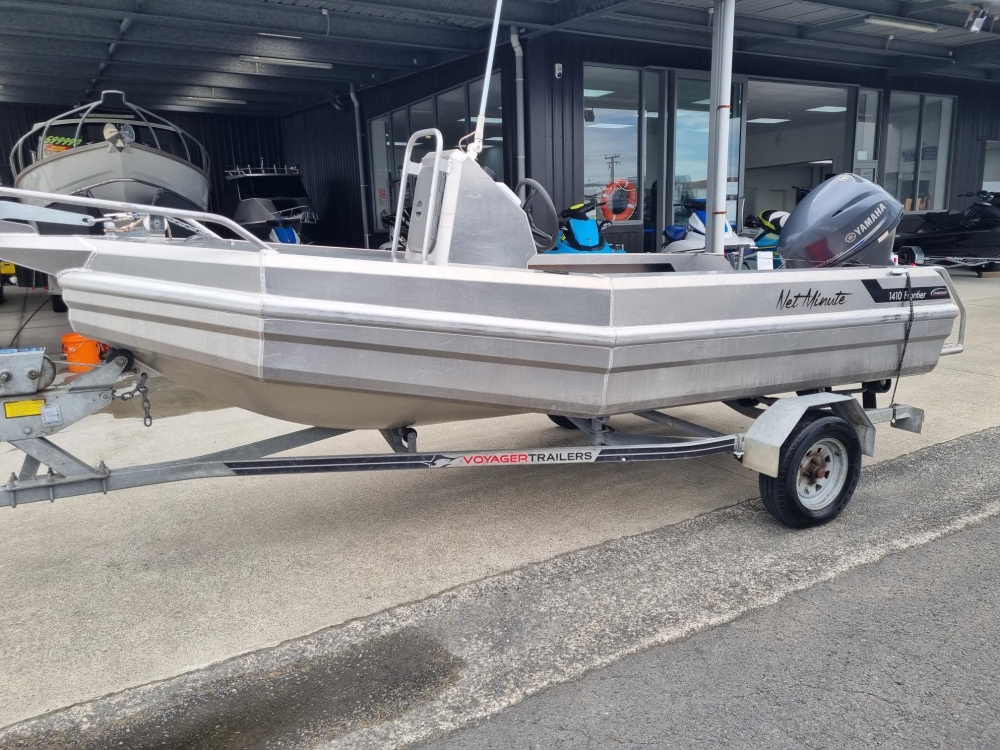
- 1410 Frontier: a centre-console version with a welded flat floor and room for up to four anglers.
In 2020 Stabicraft replaced the 1410 with the 1450, which is 120 mm longer and 190 mm wider. If you are deciding between a late 1410 and an early 1450, the newer boat has more room and stability, but the 1410 is usually cheaper.
On the water
The defining feature of any Stabicraft is stability. The pontoons give a boat this size a level, secure platform at rest, so moving around to fish or climbing back aboard after a dive is easier and safer than in a conventional small boat. Testers of the 1410 and its successors consistently highlight how stable it is for its size.
Like most small aluminium boats, it gives a firmer ride than a larger fibreglass deep-V in a chop. The sensible approach is to pick your weather and slow down in rough water.
With a 30 to 50 hp outboard, a 1410 is lively and economical. As a guide to what this size of boat does, testers of its slightly larger replacement, the 1450 Frontier, recorded close to 29 knots with a 50 hp Yamaha.
Layout and practicality
The 1410’s appeal is its simplicity. The welded aluminium floor is easy to hose out, there is little to rot or break, and the boat is light enough to launch at small ramps and beaches. Most come on a single-axle trailer, often unbraked, which suits a wide range of tow vehicles.
The Explorer gives the most open space for its size. The Frontier’s console gives you a wheel, a place for electronics and a screen, which many owners prefer for fishing. Options seen on used boats include raised coamings with rod holders, bait boards, seat boxes, canopies and graphics.
Engines
The 1410 has been sold with a wide range of outboards. In our listings, power ranged from 15 hp to 60 hp, with most boats running 30 to 50 hp. Explorers are usually tiller-steer, while Fishers and Frontiers have remote steering. Yamaha was the most common make in our listings, followed by Suzuki, Mercury and Tohatsu, with a mix of two-strokes and four-strokes.
When you look at a used 1410:
- Match the engine to how you will use it: 30 hp is enough for pottering on lakes and harbours, while 40 to 50 hp suits towing water toys or carrying more weight.
- Check the rating: make sure the motor is within the maximum shown on the boat’s capacity plate.
- Service history: small outboards are often neglected. Check for regular servicing, and run the motor from cold.
What they sell for
The prices below are asking prices, not sale prices. We have listed them with the boat’s age when it was advertised.
Recent boats.co.nz listings (2021-2026)
| Boat | Listed | Age when listed | Engine | Asking price |
|---|---|---|---|---|
| 2019 Stabicraft 1410 Explorer | 12/2022 | 3 years | Tohatsu 50 hp two-stroke tiller | $22,000 |
| 2014 Stabicraft 1410 Frontier | 03/2023 | 9 years | Yamaha F40 four-stroke | $26,000 |
| 2018 Stabicraft 1410 Explorer | 08/2023 | 5 years | Mercury 30 hp two-stroke tiller | $21,990 |
| 2017 Stabicraft 1410 Fisher | 11/2023 | 6 years | Yamaha F40 four-stroke | $27,000 |
| 2013 Stabicraft 1410 Explorer | 11/2023 | 10 years | Suzuki 40 hp two-stroke tiller | $16,000 |
| 2019 Stabicraft 1410 Explorer | 04/2024 | 5 years | Yamaha 40 hp two-stroke | $19,900 |
| 2013 Stabicraft 1410 Frontier | 06/2025 | 12 years | Suzuki DF60 four-stroke (2018) | $22,990 |
| 2019 Stabicraft 1410 Frontier | 12/2025 | 6 years | Mercury 40 hp four-stroke | $29,990 |
How well they hold their value
Stabicraft has a strong reputation for resale, and our listings back that up. New 1410 packages were listed on boats.co.nz between 2010 and 2020 at about $16,700 for a basic Explorer with a 30 hp tiller up to $31,300 for a Frontier. In 2021-2026, used boats only 3 to 6 years old have been listed at $20,000 to $30,000, and 9 to 12-year-old boats at $16,000 to $26,000.
What affects the price
- Version: Frontiers usually list higher than Explorers.
- Engine: newer four-strokes and remote steering add value over older tiller two-strokes.
- Options: raised coamings, console, canopies, electronics and graphics all add value.
- Condition of the aluminium and paint: see the checklist below.
Buyer’s checklist
- Corrosion: look for white powdery corrosion, pitting or bubbling paint, especially around fittings, the transom, the floor and where dissimilar metals such as stainless steel touch the aluminium.
- Welds and cracks: check welds around the transom, motor mount and pontoons for cracks. Hard use at speed in chop can stress welds over time.
- Pontoon integrity: the sealed chambers are a key safety feature. Ask whether they have been pressure tested or repaired, and look for dents or patches.
- Electrolysis: if the boat has lived on a mooring or in salt water for long periods, check the anodes and look for electrolysis damage.
- Engine: service records, cold start, and a compression test on older two-strokes.
- Trailer: rollers or bunks, bearings, lights, WOF and registration.
Alternatives to consider
- Stabicraft 1450: the 1410’s replacement, with more room and refinements.
- Stabicraft 1550: a bigger step up with more space, range and power.
- Conventional aluminium dinghies and runabouts: cheaper per metre, but without the pontoons’ stability and buoyancy.
- Small fibreglass runabouts: a softer ride in chop, but heavier and more maintenance.
Verdict
The Stabicraft 1410 is a simple, safe, tough little boat that does a lot well, which is why so many were sold and why they hold their value. For harbour and lake fishing, diving and family fun, it is hard to beat for its size. Buy one with a healthy, well-serviced outboard and sound aluminium, and it should give years of trouble-free boating.
Published tests and further reading
- Powerboat Magazine NZ: Stabicraft 1450 Frontier review (covers the 1410’s history)
- Boating NZ: Stabicraft 1450 Frontier ProFish review
- Trade-A-Boat: Stabicraft 1450 Frontier ProFish review
Looking for a Stabicraft 1410? Browse power boats for sale on boats.co.nz.
